
Executive view
The breakout has not earned confirmation.
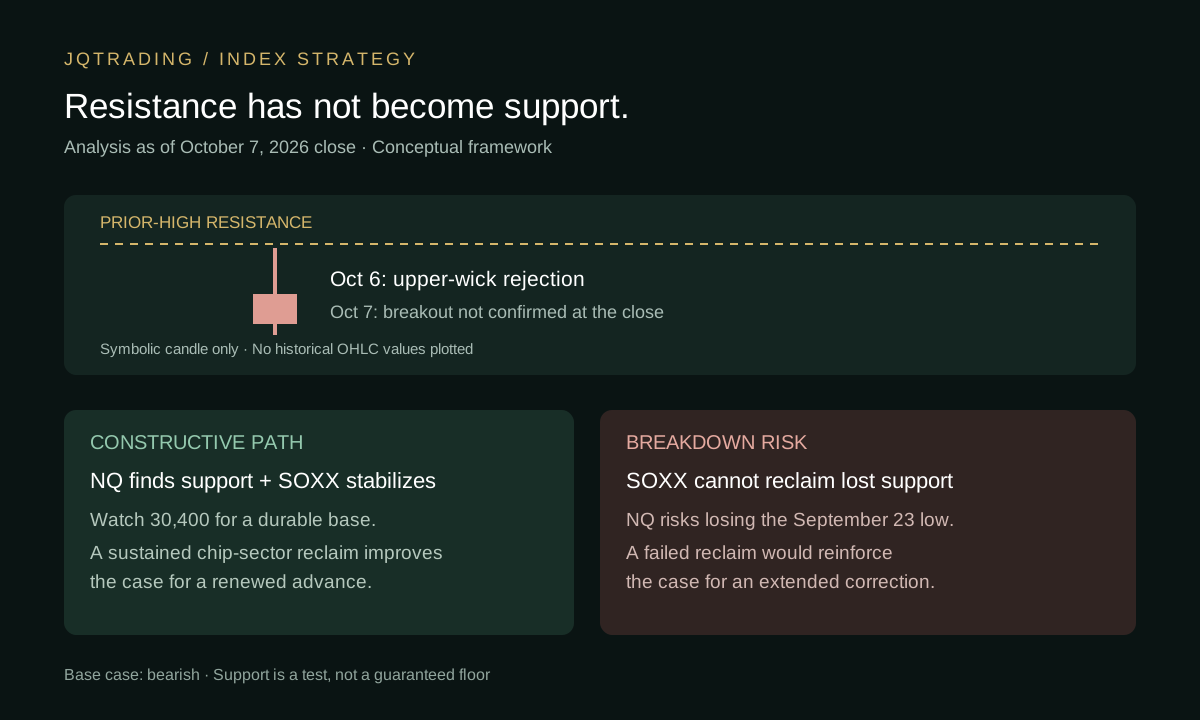
Our short-term view on U.S. equities is bearish, with NQ futures the main expression of that view. The concern is the combination of location and follow-through: an upper wick near the prior high on October 6, followed by an October 7 close that did not establish acceptance above resistance. Until buyers repair that structure, a move back toward lower support looks more likely than an immediate sustained breakout.
We look toward the September 23 NQ low as the structural downside reference. We also watch 30,400 as a potential stabilization area. A durable hold would keep a later advance possible; persistent semiconductor weakness would make that recovery harder.
Price structure
An upper wick is a warning. The next close gives it context.
An upper wick alone is not a strong enough reason to call a reversal. Healthy uptrends can absorb intraday selling and continue higher. What matters here is that the October 6 rejection appeared close to an existing high, where buyers needed to demonstrate that they could absorb supply and hold above resistance.
October 7 did not deliver that confirmation. Without a successful closing reclaim, the prior high remains an unresolved obstacle. We interpret the two-session sequence as an unsuccessful breakout attempt, rather than proof of a permanent market top. The immediate implication is a higher risk of a corrective leg and a fresh test of demand below.
Downside reference
The September 23 low is the structural test.
Our correction scenario looks toward the September 23 low on the NQ chart used for this analysis. That is a reference area where we would reassess the quality of selling and the response from buyers. It is not a guaranteed floor, nor does reaching it automatically complete the adjustment.
A constructive response would involve repeated defense of support, less downside follow-through and a rebound that survives into the close. A sustained break below that low, followed by an unsuccessful attempt to reclaim it, would instead argue that the correction is extending.
We separately watch 30,400 for stabilization. If NQ can find demand around that area and consolidate without repeatedly making fresh lows, the adjustment could still create the conditions for another advance. We do not equate 30,400 with the exact September 23 low: the latter must be read from the same futures contract and session convention used throughout the analysis.
Semiconductor confirmation
A stronger NQ recovery needs help from the chip stocks.
We expect SOXX to face pressure alongside NQ during this adjustment. We use the ETF as a gauge of semiconductor participation; the influence on NQ comes from the relevant underlying companies, rather than from the ETF mechanically moving the futures contract.
Weak semiconductor leadership could limit the strength and durability of an NQ bounce. A brief index recovery while chip stocks continue to form lower highs and lower lows would leave the broader setup vulnerable. We would treat that divergence as a warning that demand has not broadened enough to support a sustained advance.
If SOXX stabilizes and begins to reclaim the support it lost during the correction, the probability of a renewed NQ advance would improve. The useful signal is a recovery that holds, with follow-through from semiconductor constituents, rather than a single positive session.
If SOXX cannot reclaim those areas, our downside scenario becomes more concerning. NQ could revisit and then break the September 23 low, particularly if a rebound fails beneath newly formed resistance. This is a conditional risk assessment, not a claim that weakness in SOXX makes a breakdown inevitable.
Scenario framework
Three paths, with price confirmation deciding the outcome.
| Scenario | What we need to see | Implication |
|---|---|---|
| Base case: correction | NQ remains below the prior-high resistance area; semiconductors remain under pressure. | Favor a move toward the September 23 low; monitor demand around 30,400. |
| Constructive stabilization | NQ holds support and builds a base; SOXX stops deteriorating and sustains a reclaim. | A renewed advance becomes more plausible after consolidation. |
| Deeper breakdown | SOXX fails to recover; NQ loses the September 23 low and fails to reclaim it. | The correction may extend; the support-hold recovery case weakens. |
What changes our view
Resistance must become support again.
- Bearish thesis weakens: NQ closes above the prior-high resistance area, holds it on a retest and receives improving semiconductor participation.
- A bounce remains unconfirmed: NQ rises briefly but cannot hold its reclaim, while SOXX continues to lag.
- Downside risk increases: the September 23 low gives way and subsequent attempts to recover it fail.
- Recovery remains possible: a durable base around 30,400, together with a sustained semiconductor recovery, would support reassessing the bearish stance.
For now, we favor a correction before another sustained advance. We would change that judgment when price structure and sector participation improve, rather than treating a potential support level as evidence that the decline has already ended.